Create Better Real Estate Neighborhood Guides with AI

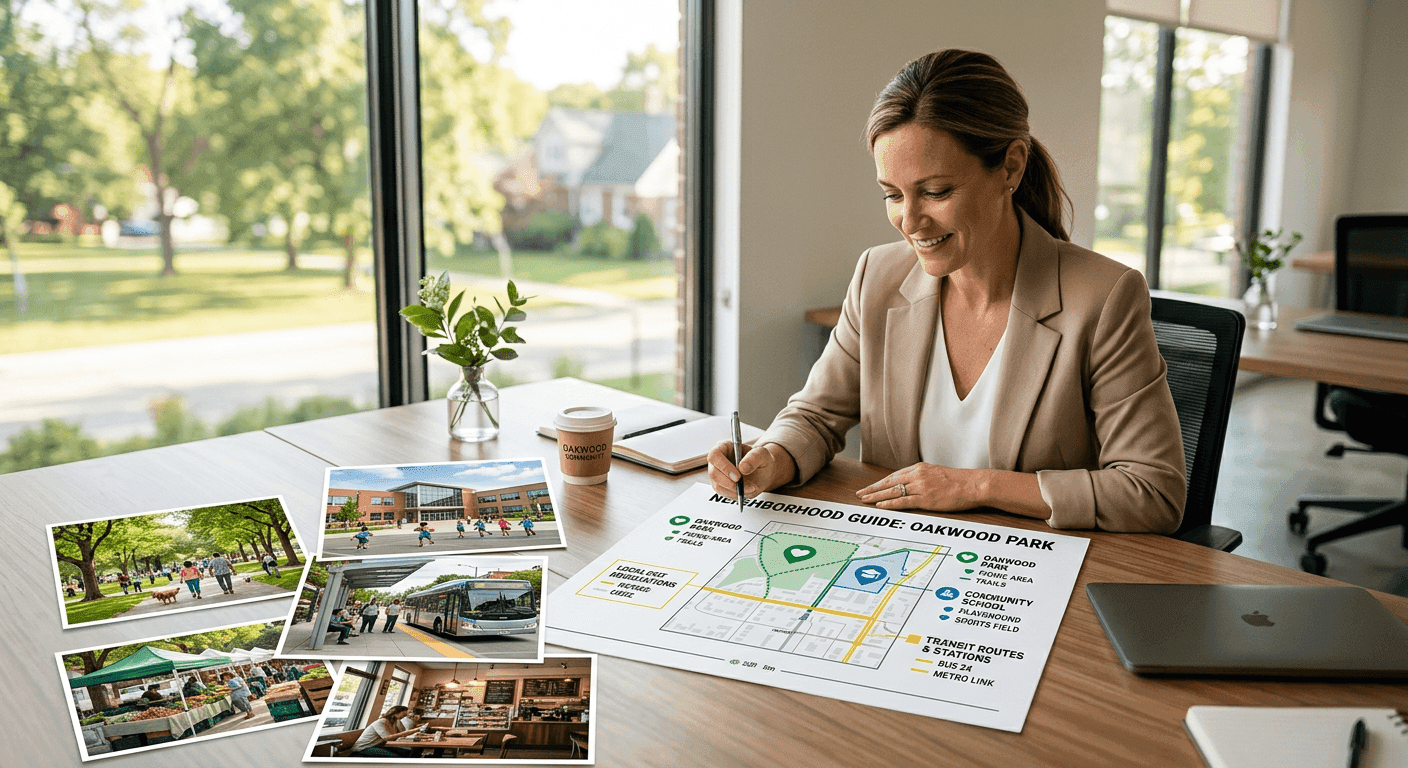
AI Neighborhood Guides for Real Estate Agents: A Practical Workflow
Most buyers start their search on a screen long before they ever call you. They scroll listings, read neighborhood pages, and form opinions about where they want to live, but they still need a knowledgeable local agent to interpret what they find. That gap between online research and real local understanding is where you win clients.
AI Neighborhood Guide Creation for Real Estate Agents can help turn scattered local knowledge, MLS trends, public data, and common client questions into useful neighborhood content that buyers actually read. The demand is clear. According to the National Association of REALTORS 2024 Profile of Home Buyers and Sellers, 89% of buyers used online websites in their home search, and 52% found the home they purchased through the internet.
The problem is that too many neighborhood pages are thin, outdated, generic, or written only to chase search rankings. Buyers need practical context: housing types, price ranges, commute considerations, amenities, schools, trade-offs, and current market activity.
In this guide, you will learn what a useful neighborhood guide should include, where AI saves time, how to avoid accuracy and fair housing risks, and a repeatable workflow for creating, reviewing, publishing, updating, and repurposing guides.
A quick note before we begin. Real estate laws, fair housing rules, brokerage policies, commission practices, MLS data access, and market conditions vary by state and market. Nothing here is legal, tax, or financial advice.
What Makes a Neighborhood Guide Useful in Real Estate
A neighborhood guide is a client-facing local resource that helps buyers compare areas, understand trade-offs, and decide where to focus their search. Done well, it does more than describe an area. It helps a buyer make an informed decision.
The best guides combine verified data, your field experience, clear explanations, practical buyer context, and current market observations. That mix is hard to fake, and it is exactly what generic pages miss.
NAR research reinforces why this matters. Its Community and Neighborhood Survey shows that buyers rank neighborhood quality, proximity to jobs, and convenience to schools and shopping among the top factors influencing purchase decisions. A guide that ignores lifestyle, commute, schools, and amenities simply will not support the decision a buyer is trying to make.
The goal is not to sell a neighborhood. It is to help buyers ask better questions and make informed choices.
Buyer Questions Your Guide Should Answer
Think about what buyers actually ask during consultations and tours, then answer those questions directly:
- What types of homes are common here?
- What price ranges should buyers expect?
- How competitive is the market right now?
- What are the commute options and typical travel considerations?
- What parks, shopping, restaurants, transit, recreation, and services are nearby?
- What school district serves the area, and where can buyers verify attendance boundaries?
- What are the common trade-offs compared with nearby neighborhoods?
The data supports this focus. In the 2024 NAR Profile of Home Buyers and Sellers, 60% of buyers cited neighborhood quality as a primary factor in choosing a home, while 39% cited convenience to jobs and 37% cited overall affordability. Those numbers are a ready-made checklist for what your guide should cover.
Where Guides Fit in Your Sales Workflow
A strong guide is reusable across your business. Common uses include IDX neighborhood landing pages, buyer consultation packets, relocation guides, email nurture campaigns, listing presentations, open house follow-up, social media posts, video scripts, and comparative market analysis conversations.
Guides help both sides of the transaction. On the buyer side, they build trust and speed up decisions. On the listing side, they demonstrate local expertise that sellers want to see.
What AI Can and Cannot Do for Neighborhood Content
AI is a content acceleration tool, not a substitute for local expertise, compliance review, or verified market knowledge. It can organize, summarize, draft, and repurpose information quickly. But you remain responsible for accuracy and for every consumer-facing claim.
The rule is simple: AI-generated copy should never be published without human review.
Best Uses for AI
AI works best when it speeds up work you would otherwise do by hand. Use it to:
- Turn research notes into a first draft.
- Create a consistent guide structure across many neighborhoods.
- Draft answers to common buyer questions.
- Rewrite content for different audiences, such as relocation buyers, first-time buyers, downsizers, or investors.
- Create comparison summaries between nearby areas.
- Draft email versions, social captions, video outlines, and printable handouts.
- Identify missing sections or unclear explanations.
A few example prompts show the pattern:
- "Summarize these MLS market notes into a consumer-friendly market snapshot."
- "Turn this neighborhood guide into a five-email buyer nurture sequence."
- "Create common buyer questions and answers using only the verified facts below."
Notice that each prompt gives the AI verified material to work from rather than asking it to invent facts.
Risks to Avoid
The risks fall into two buckets: accuracy and compliance.
On accuracy, watch for hallucinated facts about schools, boundaries, transit, zoning, or market data. Watch for outdated price, inventory, or days-on-market figures. And watch for generic descriptions that could apply to any neighborhood, which add no value and can hurt your credibility.
On compliance, the stakes are higher. HUD's Fair Housing Act guidance emphasizes that real estate marketing must avoid statements indicating a preference, limitation, or discrimination based on protected classes such as race, religion, familial status, or disability. That standard applies to AI-generated descriptions exactly as it applies to anything you write yourself. Avoid unsupported claims about safety, demographics, "best" schools, or neighborhood suitability, and avoid subjective phrases such as "perfect for families" or "ideal for young professionals."
The Consumer Financial Protection Bureau adds a related warning. Its guidance notes that digital marketing in housing-related services must comply with fair lending and fair housing laws, and that algorithms and automated tools can create legal risk if they result in discriminatory advertising or steering. In short, automating content does not remove your responsibility.
Review all AI-assisted content against brokerage standards and applicable state and local rules. When in doubt, ask your broker or qualified counsel.
A Practical Workflow for Creating AI-Assisted Neighborhood Guides
This process works whether you are a solo agent, a team, or a brokerage marketing department. Consistency is the key idea. Every guide should follow a similar structure while still reflecting the unique context of each area.
Step 1: Gather Reliable Local Inputs
Collect verified source material before you touch AI. Good inputs include:
- MLS statistics and local market reports.
- Recent comparative market analysis observations.
- Public records and tax assessor data.
- Municipal planning, zoning, parks, and public works pages.
- School district boundary and enrollment resources.
- Public transportation agency route and schedule information.
- U.S. Census Bureau data for housing characteristics, commute patterns, and population.
- Local business directories and chamber of commerce resources.
- Your own firsthand observations from showings, inspections, open houses, and buyer feedback.
The Census Bureau's data tools provide authoritative information on population, housing characteristics, commute patterns, and income by tract or ZIP code. That gives you a reliable baseline of neighborhood facts you can then contextualize with local expertise.
One habit matters most here. Label MLS data by time period and geography, such as "single-family homes sold in the past 90 days," rather than presenting it as permanent truth.
Step 2: Build a Consistent Guide Structure
Use a repeatable template for every guide:
- Short overview.
- Location and boundaries.
- Housing stock and property types.
- Current market snapshot.
- Typical price ranges.
- Amenities and daily conveniences.
- Commute and transportation notes.
- Schools and attendance boundary resources.
- Parks, recreation, and community features.
- Buyer trade-offs.
- Common buyer questions.
- A helpful call to action.
A consistent structure helps buyers compare neighborhoods side by side, helps teams maintain quality, helps brokerages scale production, and helps search engines understand how each page is organized.
Step 3: Use AI to Draft, Then Localize
Feed AI your verified notes instead of asking it to recall facts from memory. Restrict it clearly with prompts like these:
- "Use only the facts below."
- "Flag anything that needs verification."
- "Avoid fair housing sensitive language."
- "Write for buyers comparing this area with nearby neighborhoods."
Once you have a draft, add what only you can provide: local nuance, market context, common buyer misconceptions, real showing feedback, comparisons to nearby neighborhoods, seasonal considerations, and examples drawn from recent but anonymized client conversations. This is the layer that turns a competent draft into a guide buyers trust.
Step 4: Review for Accuracy, Compliance, and Tone
Run every guide through a final checklist before publishing:
- Verify all MLS statistics, price ranges, inventory data, and days-on-market numbers.
- Confirm school boundaries through district sources, and tell buyers to verify independently.
- Remove any protected-class references or coded language.
- Avoid steering buyers toward or away from neighborhoods.
- Remove unsupported safety claims.
- Check commute claims against current transportation resources.
- Confirm images, maps, and business references are current.
- Confirm the guide follows your brokerage advertising policies.
- Add update dates to all market snapshots.
If you are unsure about a compliance question, consult your broker, association guidance, or qualified legal counsel before publishing.
Content Elements Every Guide Should Include
Think of these as your minimum viable guide, the elements every neighborhood page should carry. Each one should help a buyer decide without overwhelming them.
Market Snapshot
A useful snapshot typically includes median sale price, the broader price range, active inventory, closed sales, days on market, common property types, new listings, recent activity, and months of supply where relevant.
Always label the data by time. The Federal Housing Finance Agency House Price Index, for example, reported that U.S. house prices rose 1.8% year over year and 0.8% quarter over quarter in its most recent reading. National figures like these are useful background, but neighborhood-level MLS data is far more relevant to a buyer's actual decision.
Add plain caveats such as:
- Time frame: Data reflects activity during the stated date range.
- Property type: Condo, townhouse, and single-family trends may differ.
- Sample size: Small neighborhood samples can skew statistics.
Lifestyle and Amenities
Describe amenities objectively: parks, trails, shopping, restaurants, grocery options, healthcare access, recreation, transit stops, major roads, and community facilities.
Keep the language neutral and swap risky phrases for factual ones. Instead of "family-friendly," write "near parks, playgrounds, and elementary school campuses." Instead of calling an area "safe," link buyers to official public safety resources and encourage them to review the information independently.
Buyer Fit and Trade-Offs
Trade-offs are where your expertise shows, as long as you frame them as practical considerations rather than judgments:
- Larger lots may mean longer commutes.
- Lower price points may come with older housing stock.
- Walkability may come with higher density or limited parking.
- Popular neighborhoods may have lower inventory and faster offer timelines.
Calls to Action That Feel Helpful
Keep calls to action soft and useful, matched to where the buyer is in their decision:
- Request a custom home search for this neighborhood.
- Ask for a current market snapshot.
- Schedule a neighborhood tour.
- Compare this area with nearby neighborhoods.
- Request a comparative market analysis if you own a home nearby.
- Get a relocation consultation.
How to Optimize, Update, and Repurpose Your Guides
Publishing is only the first step. The long-term value of a guide comes from keeping it current, linking it well, and reusing it across channels. Avoid the common trap of spinning up dozens of thin, nearly identical neighborhood pages, which help no one.
SEO Basics
A few fundamentals go a long way:
- Write a clear title tag and meta description.
- Use one clear H1.
- Structure the page with scannable H2s and H3s.
- Add internal links to listings, nearby neighborhoods, relocation pages, buyer resources, and market reports.
- Add image alt text that accurately describes each image.
- Include a section answering real buyer questions.
- Use map embeds where they help.
- Consider structured data where your web platform supports it.
- Show a visible "last updated" date.
- Refresh MLS statistics on a set schedule.
Google's own guidance points in the same direction: helpful, people-first content should be clear, useful, and created for readers rather than for search engines alone.
Lead Nurture and Social Media Uses
One well-built guide can become many assets. Turn it into a three-email buyer sequence, a relocation PDF, an open house handout, a listing presentation insert, a short video script, a neighborhood comparison summary, a social carousel, or a blog post on neighborhoods similar to a popular area.
AI can adapt the guide for each channel quickly without duplicating the whole page word for word. As you publish, track what works: organic traffic, IDX clicks, guide downloads, email replies, consultation requests, and neighborhood tour requests. Those signals tell you which guides to expand and which to refresh.
Conclusion: Make AI a Local Expertise Multiplier
AI can make neighborhood guide creation faster and more consistent, but your verified local knowledge is what makes a guide valuable. The balance is straightforward. Use AI for structure, drafting, editing, and repurposing. Use MLS data, public sources, and firsthand market experience for facts and context. Use human review for accuracy, compliance, and tone.
Here is a practical first step. Choose one existing neighborhood page this week, audit it for outdated data and generic language, then rebuild it using this workflow before you create your next guide. You will learn the process on a page that already needs attention.
As you go, keep following MLS rules, brokerage policies, fair housing guidance, and applicable state and local regulations. That discipline protects your business and builds the trust that turns readers into clients.
Sources
Frequently asked questions
Expand the time window (e.g., 6–12 months) and explain the smaller sample size so readers understand context. If needed, widen the geographic boundary slightly and label exactly how you did it. Supplement with objective sources like Census housing characteristics and city planning documents, plus your on-the-ground observations. Present ranges and trends rather than single-point claims.
Stick to verifiable facts such as school district names, attendance boundary links, distances to campuses, and where to confirm assignments. For public safety, point to official dashboards and encourage buyers to review them directly rather than characterizing an area as “safe” or “unsafe.” Avoid value judgments about people or groups, and don’t imply suitability for specific demographics. Rules and brokerage policies vary by state and market—confirm your approach with your broker.
Set a refresh cadence that matches activity—monthly in fast-moving markets, quarterly where volume is lower. Use saved MLS reports or exports feeding a spreadsheet that you or your team reviews before updating the CMS. Display a visible “last updated” date and note the data window used. Keep a checklist so every update gets a quick accuracy and compliance pass.
Constrain the model to your notes only and tell it to flag gaps instead of inventing details. Include instructions to avoid subjective claims, demographic inferences, or promises about safety or school quality. Require the model to list any statements that need source verification. Always perform a human edit focused on facts, tone, and compliance before publishing.
Create a reusable template and a shared source library (MLS snapshots, planning links, school resources) so drafts stay consistent. Batch AI drafts for multiple areas, then localize each with field notes and recent client questions. Assign a reviewer for accuracy/compliance and track version history and sources. This keeps AI Neighborhood Guide Creation for Real Estate Agents scalable without sacrificing quality.
Describe the primary routes, transit lines, park-and-ride options, and typical considerations like tolls or bridge bottlenecks rather than promising door-to-door minutes. Link to the regional DOT or transit schedules and suggest buyers test the commute at their normal times. Note that travel varies by time of day, weather, and construction, and keep timestamps on any examples you include.
Offer helpful, low-friction calls to action such as a saved search for the area or a downloadable checklist, and use your CRM to tag the source as the neighborhood page. Trigger a short nurture sequence with comparison content instead of aggressive pop-ups on first visit. Track conversions from internal links to IDX, guide downloads, and consultation requests to fine-tune placement.
Label the area as in flux and cite preliminary plats, city filings, and developer releases with dates. Avoid definitive claims about amenities, HOA fees, or school assignments; instead, provide verification links and contacts for the responsible agencies. Shorten your update cycle for these pages and add a prominent caveat inviting buyers to confirm details that may change mid-year.